So, about the new name.
If you caught last week’s newsletter or my IG stories yesterday, you know things are going to look just a bit different around here. Here’s the quick ICYMI: earlier this year, I got a cease and desist over the name of this newsletter.
This was not, unfortunately, my first cease and desist. Ugh, I know. Like, what are we doing over here?!

So, in the spirit of helping you avoid some of the mistakes I’ve made, a quick play-by-play:
1. The blogger-era lawsuit.
Back in the proverbial heyday of my blog, I had a roster of guest writers contributing weekly columns on wellness, astrology, beauty and, of course, travel.
In one tiny article, a writer pulled an image from Nordstrom to illustrate a beauty trend she was referencing.
And no, you very much cannot do that.
We were sued by the photographer’s agent and settled to avoid going to court. Ouch.
2. The workshop one.
This one was pretty ridiculous, tbh. I was hosting a workshop on behalf of a brand, and the brand and I came up with the name collaboratively. We ran the workshop exactly one time.
Afterward, I got a C&D because the workshop name was similar to someone else’s business. Not the same, the word that overlapped “Content”. Uhm, ma’am. But okay.
The workshop was already over and there was no real money on the line, so that went away pretty quickly.
3. The beta program.
I made the mistake of beta testing a new program without trademarking the name. As soon as we launched the beta, someone else grabbed the trademark. (Girl, were you watching and waiting, or….!)
That was that. We never used the name again.
4. And then there was The Unschool.
When I launched The Unschool back in 2021, I knew a lot less about trademarks and protecting the things I was building. I thought you came up with a name, bought the URL, started using it, and if it became a big deal, you could trademark it later.
Cute! And noooope.
Several businesses, products and legal bills later, I know better: if you’re building a brand and there’s a name you actually care about owning, trademark it.
I hadn’t done that. Completely my mistake.
So when the letter came in, I had a decision to make. I could spend the money and energy fighting to keep a name I liked, or I could ask myself how attached I actually was to it.
The answer: not enough to fight about it.
And the timing was good tbh.
I haven’t promoted the Biz School course that was attached to The Unschool name in well over a year. The education side of my business has changed quite a bit as I’ve grown the Cult Brand Blueprint™ Accelerator (very much trademarked btw) and launched Casa Noon.
So I thought: this could be a moment to pivot the news & pod a bit.
Of course I still intend to write about brands and business. But I’m equally interested in what’s happening in culture that creates these cult moments.
Why does one hotel get hot and suddenly everyone wants to book it? Remember when everyone wanted to stay in a pink trailer in Marfa, Texas? Like whhhyyyy?
Why does one weird styling decision make an outfit impossible to stop looking at? Why does one founder suddenly have everyone’s attention? What are people buying, booking, wearing, saving, screenshotting?
Basically: why do we want what we want?
And what can those of us building things learn from it?
Which is how we got to Must Be Nice.
I love those three words because, depending on how you say them, they can mean admiration, envy, curiosity, desire, or a little bit of side-eye.
Must be nice. Must be nice. Must be nice. (You can read it so many ways!)
It felt like the perfect name for a newsletter about taste, culture, brands, consumer behavior and the business of making people care.
So that’s what you’re getting around here now.
And in the spirit of the new name, let’s start with some extremely well-dressed men I saw in Paris.
I SAW A THING
The +1 Theory
This summer, I was sitting at a café in the Marais with my friend Alex during Men’s Fashion Week. We were in Paris for a few days before heading down to Cannes for the Festival of Creativity. It was peak summer Euro season, the café tables were full, and the people-watching was VERY good.
There was one table Alex and I were particularly enamored with. Two guys whose looks we were kinda drooling over.
One was wearing a suit with a pop of color, cowboy boots, a vintage ball cap, and a rhinestone chain dangling around the hat.
Another paired a basketball jersey with wide-leg dress pants and loafers... and then put a boater hat on top of the whole thing.
We started dissecting why the outfits were so good.

Because it wasn’t simply that there was a lot going on.
Take the vintage hat off the first guy and the suit still looks good. Take the boater off the second and the jersey, trousers and loafers still work.
But each outfit had one more decision. One thing that interrupted the rest of it.
A +1.
And once I saw it, I started noticing versions of it everywhere.
For the last few years, status has been very much about knowing the codes. No logos. Perfect beige. The Row. A bag so plain you had to already know it cost $4,000 to understand why anyone cared about it. Then everyone learned the codes.
We all got the beige sweater. Dupes made the understated bag accessible. TikTok taught millions of people exactly which loafer, jean, jacket and sunglasses communicate I summer somewhere expensive.
Btw, have y’all seen this account? OMG, so good.
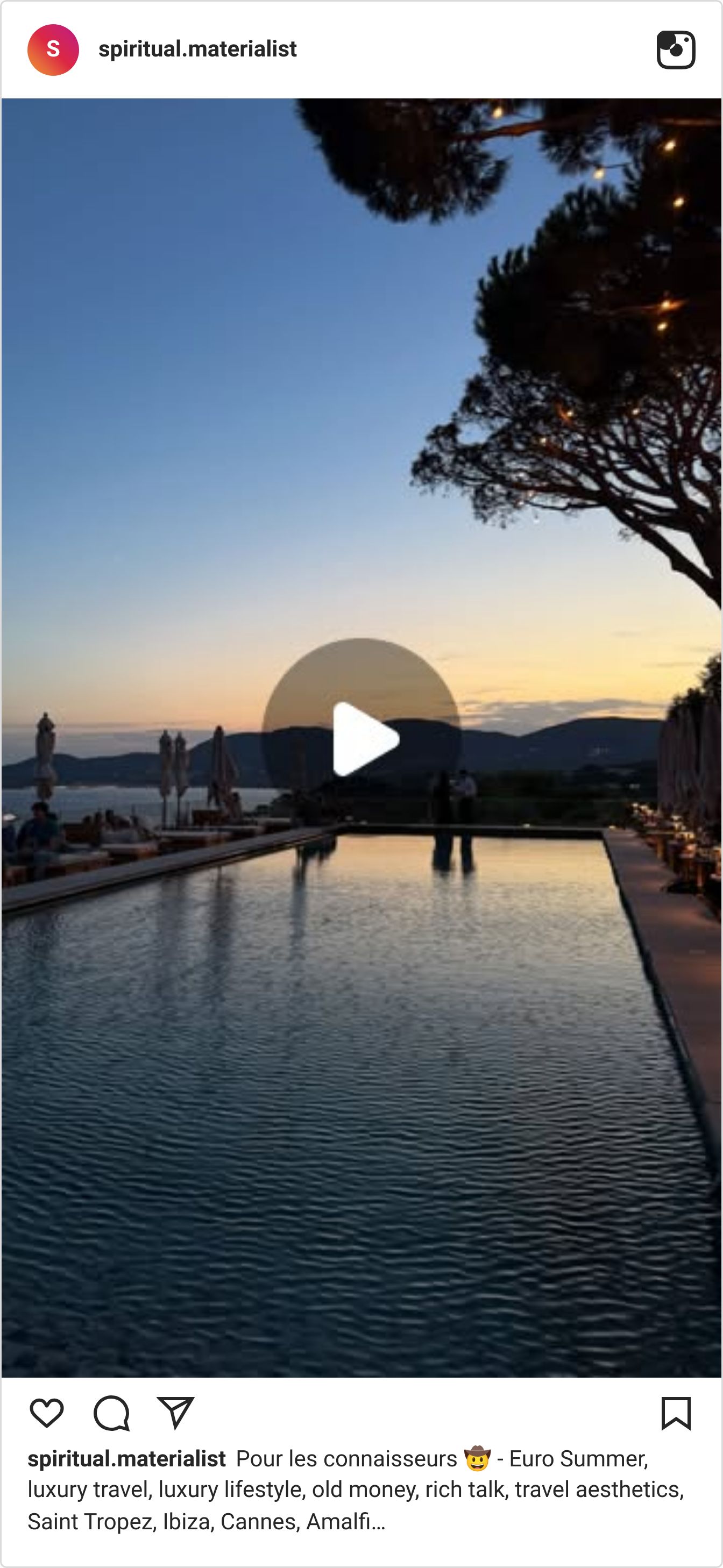
This is what happens when trend reporting happens literally in real time: we all learn the codes at the same time. We all figured out how to look like we summer somewhere expensive without actually summering somewhere expensive.
So looking expensive isn’t particularly hard anymore.
Looking specific is.
And Gen Z is SO good at this. A corset over cargo pants. Jelly shoes. A cowboy hat. Three prints fighting with each other. The charm-covered bag. The weird sock. The vintage piece from an entirely different decade.
You’re not looking at the outfit thinking, where did she buy that? You’re thinking, how did she even think to put those together? That’s a completely different kind of status.
And before someone gives this a TikTok name and declares it a new aesthetic, maximalism itself is obviously not new. South Asian, Nigerian and Black American style have been doing color, print, embellishment and layering forever. The mainstream is just clocking it again and inevitably giving it a new name.
But I don’t think maximalism is really the point. I love looking to the runways for what might be coming next because there’s inevitably a designer or two just a smidge ahead. Consider Demna, who is doing almost the exact opposite of this look-at-me-luxe maximalism at Gucci right now.
While everyone else is layering and clashing and adding, he’s coming in sexy, stripped back and incredibly specific.
Which gets us back to the guys in Paris. It’s not about how much you add. It’s about the decision that makes the whole thing recognizable. And I think brands need a +1 too. Because we’re all very, very good at making things look good now. You can build a Pinterest board in an afternoon. Find the font. Buy the Shopify template. Hire the photographer. Screenshot the brand you like. Ask AI for 40 variations.
The codes are readily available.
Which means I see a lot of brands where I understand every single decision that was made. Nice logo. Nice type. Nice packaging. Nice photography. Nice founder. Nice feed. Everything goes.
And sometimes that’s exactly the problem.
The brands I remember usually have at least one decision I wouldn’t have told them to make.
A weird partnership. An oddly specific phrase. Packaging that doesn’t look like anything else in the category. An event that makes very little sense according to a traditional marketing calendar.
The thing someone probably suggested taking out.
That’s the +1.
And no, this does not mean adding something random to your brand for the sake of being weird. The reason the boater hat worked is because the guy wearing it clearly knew what he was doing. Taste is knowing the codes well enough to know which one you can mess with. And as everything else becomes easier to replicate, I think that’s going to matter a lot.
You can dupe a bag. You can copy an outfit. You can screenshot someone’s entire Instagram feed and hand it to a designer. It’s much harder to dupe a point of view that’s actually yours.
I HAVE QUESTIONS
The curious case of Selena Gomez’s two companies
Selena Gomez accidentally ran a nearly perfect experiment on celebrity brands. I talked about this the other day, but the story gets more interesting the further you go into it.
Wondermind, the mental health company Selena co-founded, is being sued by some of its investors, who allege they were misled about the company’s financial health and business prospects. And as a founder who recently took investor capital myself, my immediate reaction was: uhhhh oh. This is NEVER something you want to see.
So I started looking at who was actually involved, because Wondermind wasn’t simply Selena Gomez starts a mental health company.
There were three co-founders.
Selena, who brought an enormous audience, cultural relevance and a very real personal connection to conversations around mental health.
Her mother, Mandy Teefey.
And Daniella Pierson, an entrepreneur who had already built The Newsette, a media company she founded while she was in college.
Wondermind launched in 2021 around the idea of “mental fitness.” Content was part of it, but the ambition was much larger. The company talked about building an ecosystem of products and tools, including an app. It raised money. It attracted high-profile investors. And on paper, you can see the pitch.
A major celebrity with hundreds of millions of followers + a founder with media experience + an enormous consumer category + a very personal reason for the company to exist.
You would probably take that meeting. But then the founding team changed. Daniella left Wondermind in 2023. The investors now suing the company allege they were initially told she’d left voluntarily and later learned she’d actually been asked to leave amid accusations involving company funds.
Daniella has denied wrongdoing. The allegations in the lawsuit haven’t been proven in court. The investors make other claims too, including that the app they believed the company was building never materialized and that they weren’t given an accurate picture of what was happening inside the business.
Selena is fighting the claims against her and argues that she wasn’t involved in managing Wondermind or in the communications the investors say misled them.
And that’s where this became much more interesting to me than a celebrity lawsuit.
Because Selena has another company.
You may have heard of it 😉.
Rare Beauty.
Rare is reportedly worth around $2 billion and has become one of the biggest celebrity beauty success stories of the last several years. Same Selena. Same enormous audience. Same personal connection to mental health woven into the company. Completely different outcome.
So I went looking at who built Rare.
Rare’s CEO is Scott Friedman, the former CEO of NYX Cosmetics.
He brought other experienced operators into the company. People who already understood product development, operations, digital, retail, and what it actually takes to build a global beauty business. That detail changes the story for me completely.
We’ve spent the last decade treating fame like a cheat code for entrepreneurship.
Put a famous person on it. Give them a title. Borrow their audience. Watch it sell.
It’s why we’ve had approximately nine million Kardashian-Jenner brands. They have their own versions of Scott Friedman, of course. Hi, Emma Grede.
Somewhere along the way, we started confusing:
I know who you are.
with
You must know what you’re doing.
Those are very different things. If Selena’s audience were the primary reason Rare worked, Wondermind should have worked too. 400+ million followers can get a lot of people to look at something. They cannot make payroll. They can’t build an app. They can’t forecast cash, manage a cap table, negotiate manufacturing, run retail operations, hire the right people, or make three founders with completely different skill sets work well together.
Those are company-building problems.
And Rare’s story is interesting because Selena doesn’t appear to have approached the company as though being Selena Gomez made her magically qualified to solve all of them. She knew what she brought. Vision. Taste. Community. An enormous platform. A deeply personal mission around mental health.
Then she surrounded herself with people who knew how to turn those things into an actual beauty company.
I care about this beyond the gossip for a pretty obvious reason.
I’m building a beauty company too.
Just without 400 million followers, which feels slightly unfair but we’ll carry on.
Building Casa Noon has made me VERY aware of the edges of my own expertise.
I know brand. I know the consumer. I know how to create a world people want to participate in. I understand marketing, storytelling, community, partnerships, and how to see cultural shifts early enough to actually do something with them.
I did not wake up magically understanding cosmetic chemistry, OTC regulation, packaging engineering, manufacturing, supply chain, or retail operations because I decided to become a beauty founder.
So I have people.
Even at this early stage, when the budget is very real and very limited, I’ve found ways to get smart people around the business. And then I have people who know people. And I ask approximately one million questions.
Because success in one area can make it very easy to start believing you’re probably pretty good at everything. You’re probably not. Neither am I.
And for those of us building companies without celebrity budgets, I actually find that encouraging.
You need to know what you’re exceptionally good at.
And you need to know when the business needs a Scott or an Emma or a version of them on the come up.
Maybe you can’t afford the Scott Friedman yet. I certainly can’t.
But you can find the person who has done this before. You can build an advisory bench. You can ask for the introduction. You can join an accelerator. You can hire someone for five hours instead of fifty. You can find the consultant, the fractional operator, the friend of a friend who will take the call.
I’m finding versions of those people every day while building Casa Noon.
You don’t need to know everything.
You do need to know when you don’t.
🧠 Smart Girl Opportunities
1. Content Weekend New York is sold out. But you can get on the waitlist for the next one. These are focused weekend events for founders who want to get their visual story right in a room full of other creators building cult brands. → Waitlist here
2. Cult Brand Accelerator — Fall Cohort Begins in September. This is where founders do the actual brand infrastructure work together — structured, specific, and in community. If you've been thinking about it, this is the cohort to do it in. → Register here
In partnership with

Your Boss Will Think You’re an Ecom Genius

You’re optimizing for growth. You need ecom tactics that actually work. Not mushy strategies.
Go-to-Millions is the ecommerce growth newsletter from Ari Murray, packed with tactical insights, smart creative, and marketing that drives revenue.
Every issue is built for operators: clear, punchy, and grounded in what’s working, from product strategy to paid media to conversion lifts.
Subscribe free and get your next growth unlock delivered weekly.
More Ways to Work With Oui, We Studio
Fractional CBO — Brand Direction: Think of me as your brand sherpa: I know where you're going, how to get there, and I make sure nothing goes out misaligned. Monthly strategy call, updated content plan, and a brand strategy document — all built on the Cult Brand Blueprint™ framework. Our next opening for this work is September.
The Content Studio Brand strategy from me. Content from my Studio team, created and delivered to you each month — ready to post. Photo-forward or video-forward, depending on where your brand lives and what we decide you need.
→ Let us know you're interested here, and we'll set up time to chat.

Did someone forward this to you? Subscribe for a weekly dose of No Gatekeeping Strategies, Cult Brand Thinking, and Smart Ideas.