In partnership with

Last Sunday, while I was on a plane to Vegas to speak to a packed house of Oribe artists about finding your brand identity, the Victoria's Secret Fashion Show was having quite the moment with supermodels, wings, Megan Thee Stallion, Tate McRae, KATSEYE, Megan Moroney, and a whole lot of nostalgia.
Kylie Jenner, reality TV royalty turned beauty mogul and once famously dubbed a “self-made billionaire” (lol, ha f’n ha okay), made her Victoria's Secret debut wearing a $50 million Fantasy Bra.
Adriana Lima, Alessandra Ambrosio and Candice Swanepoel were back. And at its peak, 3.64 million people were watching the livestreams simultaneously, up nearly 33% from last year.
Victoria's Secret got hot again.
But the part I'm most interested in actually happened way before the runway show.

Did you know that as part of the brand's big comeback, more than 100,000 women applied to become the next Victoria's Secret Angel? And VS, being very clever about the whole thing, turned the nationwide casting process into a seven-episode YouTube docuseries called Angels Among Us. There were auditions, eliminations, finalists, personal stories and, eventually, a winner revealed on the runway.
And they also hosted live screenings of the fashion show at select AMC theaters, where fans could gather to watch the whole thing together.
Yes, the same lingerie company that we elder millennials begged our moms to take us to at the mall, where we'd wander around sniffing Love Spell and dreaming of the day we could afford the matching sets, produced a reality competition series, staged a live entertainment event, and got millions of people to tune in.
But of course they did.
Give us a cast of characters, a little anticipation, a few people to root for, and a big finale, and we'll make an evening of it. The underwear company clearly has a programming department now.
And once you start noticing it, so does every other hot brand. Here’s more on the topic:
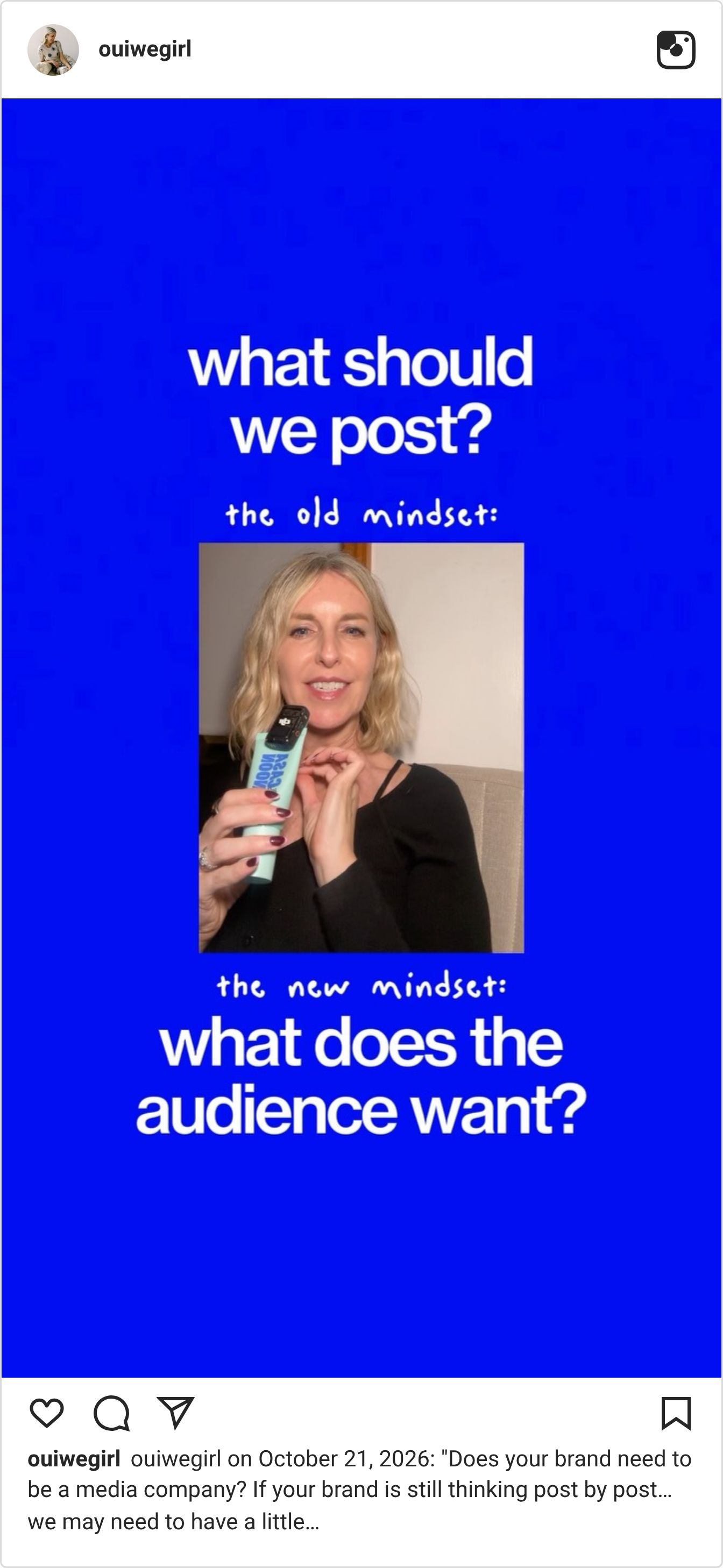
Every cool brand seems to have a media company tucked inside it.
Victoria's Secret is a particularly interesting example because the brand has had a front-row seat to what happens when you lose your cultural relevance.
Remember when the Angels were basically pop stars?
In the early and mid-2000s, the fashion show was appointment television. Heidi Klum, Tyra Banks, Gisele Bündchen. There were countdowns and backstage specials. The Angels were household names, and everyone seemed to have an opinion about the show.

Then the brand started falling out of favor. The cultural conversation around beauty and bodies changed, criticism mounted, and the show was canceled in 2019. A few attempts at reinvention followed. They tried a lot of things: a new direction, new faces, a refreshed approach to inclusivity. And eventually, a return to the runway.
But this year's playbook is the one that seems to actually be hitting.
The casting docuseries (which is sitting at 7.7 million views as I write this) gave people a reason to follow along for weeks. By the time the fashion show happened, audiences already knew the women competing to become Angels. They had favorites and knew their stories and wanted to see what happened next.
If you were following along on Threads or IG, it felt like the audience was a cheering section for the models rather than reporters on or consumers of the garments themselves.

Why? Because Victoria's Secret gave the audience a plotline.
And tbh, that's quite a smart way to rebuild cultural relevance. Because the show now has all the ingredients of a media franchise: familiar characters, episodes, anticipation, a big finale and a reason to return for another season.
So many cool brands have a similar approach. Let’s look at three:
01. Nude Project has a podcast. And a whole lot of other things going on.
Nude Project is one of my favorite examples because it's a relatively young streetwear brand with a completely different budget and business model than Victoria's Secret.
Founded in Spain by two young entrepreneurs, the brand started with sweatshirts and a very specific point of view on creativity, youth culture and doing your own thing.

Nude Project in WWD
Fast-forward a few years, and there's the Nude Project Podcast, featuring conversations with artists, musicians, entrepreneurs and cultural figures.
They've built out running clubs, workshops, parties and other community experiences too. What's particularly clever here is that the content and experiences reflect the lifestyle of the people buying the clothing.
If you're interested in the people, conversations and creative culture Nude Project covers, you might spend hours with the brand without visiting a product page. And when you eventually see someone wearing a Nude Project hoodie, it means something beyond the clothing itself.
There's a whole little world attached to it.
02. Miu Miu has been making films for FIFTEEN YEARS.
I love that we're all talking about brands becoming media companies in 2026 because Miu Miu has basically been doing this since 2011.
Their Women's Tales series commissions female filmmakers to create short films exploring femininity, identity and culture. They’ve created thirty-two films so far. The most recent, Avec Kim, was directed by acclaimed French filmmaker Claire Denis and premiered at the Venice Film Festival in September.
And the project has expanded beyond film into Tales & Tellers, a live performance and art experience that has traveled to Paris, New York and Shanghai. That's 15 years of a fashion brand commissioning artists, showing films, developing a cultural archive and giving people reasons to pay attention between collections.
Think about what that does for Miu Miu's identity.
Every director they choose, every story they commission, every artistic collaboration tells us something about the brand's taste. And the consistency of those choices means that, over time, we start to understand what Miu Miu believes belongs in its world.
03. And Saint Laurent has an actual film production company.
Saint Laurent Productions has participated in films directed by Pedro Almodóvar, David Cronenberg, Paolo Sorrentino, Jacques Audiard and Jim Jarmusch. If those names alone don’t tell you exactly what LV’s perfect person looks like in taste and style.
Obviously, most creatives and founders reading this newsletter will not be casually financing a film by David Cronenberg next quarter. I get that. If you are, please invite me to the premiere.
But there's something worth studying here that has very little to do with the size of the production budget.
Saint Laurent has decided that cinema belongs within the creative territory of its brand. And by participating in the production of films, the house has a hand in shaping that cultural territory.
Miu Miu has done something similar with women filmmakers. Nude Project is doing it through conversations and community experiences. Victoria's Secret is doing it through entertainment and a familiar fashion-show franchise.
Four brands. Four very different approaches. BUT! There's a common thread.
They're creating things people can become fans of, tune into, discuss at the proverbial water cooler, in addition to the things people can buy.
So what happens when we start thinking like a programming director?
I've spent a lot of time teaching founders how to build content systems, and I'm doing this myself on a baby budget for my own beauty brand, Casa Noon. And I know how easy it is to get caught up in the logistics of content creation.
How many posts do we need this week? What format is performing best? What can we batch film? What does the algorithm want from us now?
Just this past Wednesday, I was in New York hosting a workshop with my friends at Planoly and Bento, and during our content planning session, so many of the questions centered around the algorithm. Posting schedules, Reel lengths, content formats, what works right now, what doesn't.
And listen, these are fair questions. Necessary ones, even, when you're running a business and trying to make every piece of content count. But the question I didn’t hear:
What would our audience actually tune into?
Imagine approaching your brand's content the way an editor approaches a magazine, or a producer develops a television show. You'd need a premise. A point of view. A reason for someone to care enough to come back for the next installment.
You'd think about the stories worth telling, the recurring characters, the conversations your audience wants to be part of, and the little things that make a format recognizable. And suddenly, the question of whether your Reel should be 30 or 60 seconds feels a lot less interesting.
You'd decide which stories belong in your world.
You'd create recognizable formats. You'd develop recurring features, bring in interesting personalities, maybe launch a special edition or build toward a season finale. You'd give people some idea of what was coming next.
And perhaps most importantly, you'd have to consider what would make someone choose to spend their time with what you're creating. Because being followed and being watched are two different behaviors. Someone can follow a brand on Instagram because they liked a photo six months ago.
But when they remember the name of your recurring series, look forward to the next installment, or invite a friend to one of your events? That's a different relationship.
I think about this with Must Be Nice, too.
My little corner of the internet is increasingly a place to investigate why we want what we want. The brands we're talking about, the places we're going, the things we're buying, the people whose taste we trust.
I have a particular interest in understanding the decisions behind those cultural moments and what founders can learn from them.
That's the editorial territory. This newsletter is one way I get to explore it every week.
And I'm interested in what happens when more founders start approaching their businesses with that kind of intention.
So maybe you’re saying, I get it. Then, the next question should be:
Okay, so what's on my network?
Let's make this practical.
You don't need to hire a production company or suddenly announce that you're launching a documentary series. Though if that's been sitting on your vision board, by all means.
Start with three things.
01. YOUR EDITORIAL THESIS
Figure out what your brand would cover.
If your brand were a publication, what would its editorial territory be?
And I'm going to encourage you to look a little further than your immediate product category. A skincare company could talk about ingredients, routines and product benefits all day. But what if the founder is obsessed with coastal towns, old beach clubs, surf culture and the way people spend their summers? (hi, it me).
Now there's a broader world of stories to explore.
A hospitality brand might have a point of view on music, local architecture and the art of being a regular. A jewelry brand might be fascinated by heirlooms, family stories, sentimental objects and the things people keep for decades.
These interests are clues.
Your editorial thesis should be specific enough to help you decide which stories to cover, which guests to invite and which opportunities to pass on.
02. YOUR OWNED PROPERTY
Give people something they can recognize by name.
This is where I'd like you to start thinking about a recurring format.
Maybe you're an interior designer with a monthly series called Why This Room Works, where you investigate one fascinating space and the specific design decisions behind it.
Maybe you own a salon and start After Hours, a monthly gathering with local creatives, music, cocktails and a conversation about something happening in your city.
Maybe you're a jewelry designer who creates Objects of Affection, interviewing interesting women about the one thing they own that they'd never part with.
There are so many possibilities here.
The idea is to develop something with an identity of its own, while still being unmistakably connected to your brand. You want someone to be able to tell a friend about it without having to explain your entire business first.
03. YOUR PROGRAMMING
Give people a reason to come back.
Once you have the idea, think about how it repeats.
What happens in every episode? How often does it appear? What can people expect? Which parts stay familiar and which parts change?
And eventually, what might season two look like?
There's a reason people love recurring segments, annual events, special editions and familiar rituals. They start to become part of how we organize our time and what we look forward to. The Victoria's Secret example is interesting because the brand already owned a cultural event people know. This year, it created an entire series of moments leading up to that event.
Most founders aren't starting with a decades-old franchise. But you can begin developing a recurring property today. And after enough repetitions, people start recognizing the format. Then they start anticipating it.
And eventually, if you do it well, they start telling other people about it.
📝 YOUR CULT BRAND HOMEWORK
Make a TV Guide for your brand.
Remember those little TV Guide descriptions that told you exactly what was on, who was in it, and why you should watch?

I want you to write one for your brand.
Give yourself 20 minutes and fill in these five blanks:
THE NETWORK: What's the editorial territory your brand wants to be known for?
THE SHOW: What's one recurring property you could create? Give it a name.
THE PREMISE: In two sentences, explain what happens and why your audience would find it interesting.
THE SCHEDULE: Does it come out weekly, monthly, seasonally or around a particular event?
THE PILOT: What's the very first episode, gathering, interview or edition going to feature?
Then write the little TV Guide listing.
If it sounds like something your ideal customer would actually put on their calendar, you're getting somewhere.
And if you're reading this thinking, Okay, I kind of want to start a magazine now, hi. Same. The format could be tiny. A recurring newsletter feature, a short interview series, a quarterly dinner or a monthly community gathering.
The interesting part is how quickly a single idea can start to develop its own lore, aesthetic, language and rituals once you commit to making it a recognizable part of your brand.
Okay. Now go pitch yourself a show.
I want a title, a premise and a pilot episode.
I’d love to hear from you as you do this work. Pop a note over, send me a DM, tag me when you create your first post for your new series, or send me a copy of your zine when you make it.
🧠 Smart Girl Opportunities
01. CULT BRAND BLUEPRINT™ ACCELERATOR: January Cohort is Open for Enrollment
If you're thinking about giving your brand a bigger editorial world, our six-week accelerator is where we build the foundations that make that possible.
We work through your Perfect Person, Founder Lore, POV, Voice, Aesthetic, Rituals and content system, with live guidance from me and our strategist.
02. CREATE YOUR SIGNATURE VISUAL STYLE
A free 30-minute masterclass
I have a free visual style masterclass where I'm teaching you how to discover your brand archetype, develop your signature aesthetic, and create a B-roll shot list that makes filming content so much easier.
We'll get into planning, filming, and creating the kind of visual content that makes your brand recognizable, even if you're shooting everything yourself on your iPhone.
It's free, and you can choose a time that works for you.
03. READ MORE BOOKS FASTER WITH SHORTFORM
The 5 Ideas From Atomic Habits That Actually Stick

Most people who read Atomic Habits remember one line: small habits compound. Here's the rest worth keeping:
Focus on systems, not goals
Build habits around who you want to become
Make the good habit the easy one
Design your space so the right choice is the default
Shortform breaks down books like Atomic Habits into the key ideas, the reasoning behind them, and how to put them to work. This one takes about 15 minutes.
Then do the same for the next book on your list.
More Ways to Work With Oui, We Studio
Fractional CBO — Brand Direction: Think of the studio team as your brand sherpa: we know where you're going, how to get there, and we make sure nothing goes out misaligned. Monthly strategy call, updated content plan, and a brand strategy document — all built on the Cult Brand Blueprint™ framework. Our next opening for this work is September.
The Content Studio Brand strategy from me. Content from my Studio team, created and delivered to you each month — ready to post. Photo-forward or video-forward, depending on where your brand lives and what we decide you need.
→ Let us know you're interested here, and we'll set up time to chat.

Did someone forward this to you? Subscribe for a weekly dose of No Gatekeeping Strategies, Cult Brand Thinking, and Smart Ideas.
Want more Unschool in your ears? Listen to the Unschool Podcast here.