REMINDER: Cult Brand Accelerator enrollment is open for our September cohort — this is where founders do the actual brand infrastructure work together, structured, specific, and in community. Register here.
I'm writing this newsletter from breakfast overlooking the Petronas Towers in Kuala Lumpur. I'm here to give a keynote for the brand Oribe, specifically for their Australian team. Two summers ago, I set a goal to make speaking engagements a larger part of my revenue, and this summer I can look back and see how that goal became reality.
I've written about shooting your shot (I do a lot of that) and being your own editor-in-chief, and while getting closer to any big goal requires more than those two things, they absolutely help. A lot.
Before we get into this issue, a little newsletter update. This is the final issue of this newsletter under the name "The Unschool News & Pod."
And here's why. I attempted to trademark the name The Unschool a few years ago, and wasn't able to get it. There are quite a few other businesses operating with that name. Of course, this was a learning lesson, as I'd already been producing the podcast under the name for quite some time when it occurred to me to get the TM. I don't create things without a TM conversation with my attorney these days, but I didn't know back then.
So, now, without getting into the details, I'm having to change the name. I received the ol' cease and desist a few months back, and tbh the negotiation was a pretty simple one, because I decided to take it as a sign that it's time to retire the name The Unschool.
So, in the next issue I'll reveal the new name of the newsletter and pod. And some other brand extensions I've been working on over here. (Will she launch a substack, maaaybe, but I promise it won’t be a regurgitated version of this newsletter).
Now, to get into this issue.
We're going to talk about the "girls" of the moment.
The "it girl," the "cool girl," the "kinda-chic girl," the "business baddie," and finally, the "smart girl." (She's always been my favorite, of course.)
Of those first four terms, they've been used so many times that everyone's one now. And when everyone's an it girl, being called one stops meaning anything. My OG it girls, for the record: Alexa Chung, Cher, Marisa Berenson, the Olsen twins, Paris Hilton.
Women whose taste and style really hadn't been seen before.

This may be a hot take, but one of the things I've noticed with the rise of companies like Create & Cultivate, Female Founder World, and podcast networks like Dear Media, is that we've started using "it girl" as a shortcut for judgment. We let the anointed girl tell us what's true. Often she's also the girl who really knows her stuff. She's not just an "it girl," she's also a really, f'n smart girl.
But sometimes, there's something else behind it.
Case in point: we crowned Phoebe Gates the business it girl. I talked about this in the Shoot Your Shot newsletter too. She's a Gates, and the Phia story is a good one. Two Stanford roommates build a business in their dorm room. They land a Forbes cover. They launch a podcast landing big-deal guests like Chelsea Handler, Kris Jenner, and Karlie Kloss.
Phoebe has spoken at and moderated panels at major global and industry gatherings, including the Goalkeepers event in New York, SXSW in Austin, and Business of Fashion's VOICES summit, as well as virtual series like Georgetown University's Venture in the Capital.
I've been in the audience for some of these. And rarely does anyone ask the obvious question about her success. (I don't have to tell you what that question is.)
So then Phoebe's company, Phia, raised around $35 million from investors like the Jenners, Sydney Sweeney, and Hailey Bieber. Then Bloomberg actually looked under the hood, and Phia gets accused of "cookie stuffing" — claiming affiliate commissions on sales it didn't drive. Phia says it was unintentional and that they fixed it.
I'm not here to litigate whether that was a mistake. Bloomberg continues to report on this, and it seems pretty obvious that it wasn’t. But that's not my point. My point is that nobody was checking until it became a headline, because her crown did the vouching for her.
This isn't me tearing down young female founders. It's the opposite. I want the women doing the actual hard, unglamorous work to get seen. Which is exactly why this matters: when we hand out the crown based on a last name and a vibe, we skip right past the women grinding without either. And when an anointed one stumbles, it splashes back on every woman building the real way.
Which brings me to the flip side of that same coin, and honestly the more optimistic half of this conversation. Because the internet didn't just create a credibility problem with it, girls. It's also creating the correction in real time.
And before I talk about this side of things, I'd be remiss not to state for the record: my most recent round of investors for Casa Noon are all in the creator economy, and they'd rather be known as stakeholders in something they believe in than chase their next ten thousand followers. Being seen as someone who knows is cool right now. And quietly, it's lucrative.
So let's get into the actual shift.
But first, some context if "knowledge creator" is a new term for you:
It's the label for creators whose content leads with expertise instead of aesthetic — explainers, breakdowns, "here's why," instead of "here's my life."
Educational content is now one of the top-performing categories on every major platform, Substack is having a real moment, and it's the direct response to the credibility problem above: once the crown stops meaning anything, the people who actually know something become the only reliable signal left.
Here's how that's playing out.
1. The label people used to want is now the label people are running from
Look at the biggest "tradwife" creators right now — the ones who blew up selling an entire aesthetic, the homestead, the from-scratch everything. Half of them are suddenly insisting they're not tradwives. Why? Because they're smart businesswomen, and they can feel the label went from aspirational to a little bit cringe. The influence still works, of course; it’s not like these creators are getting less work. But being seen as influencing is what they're distancing from.
I talked about this more here:
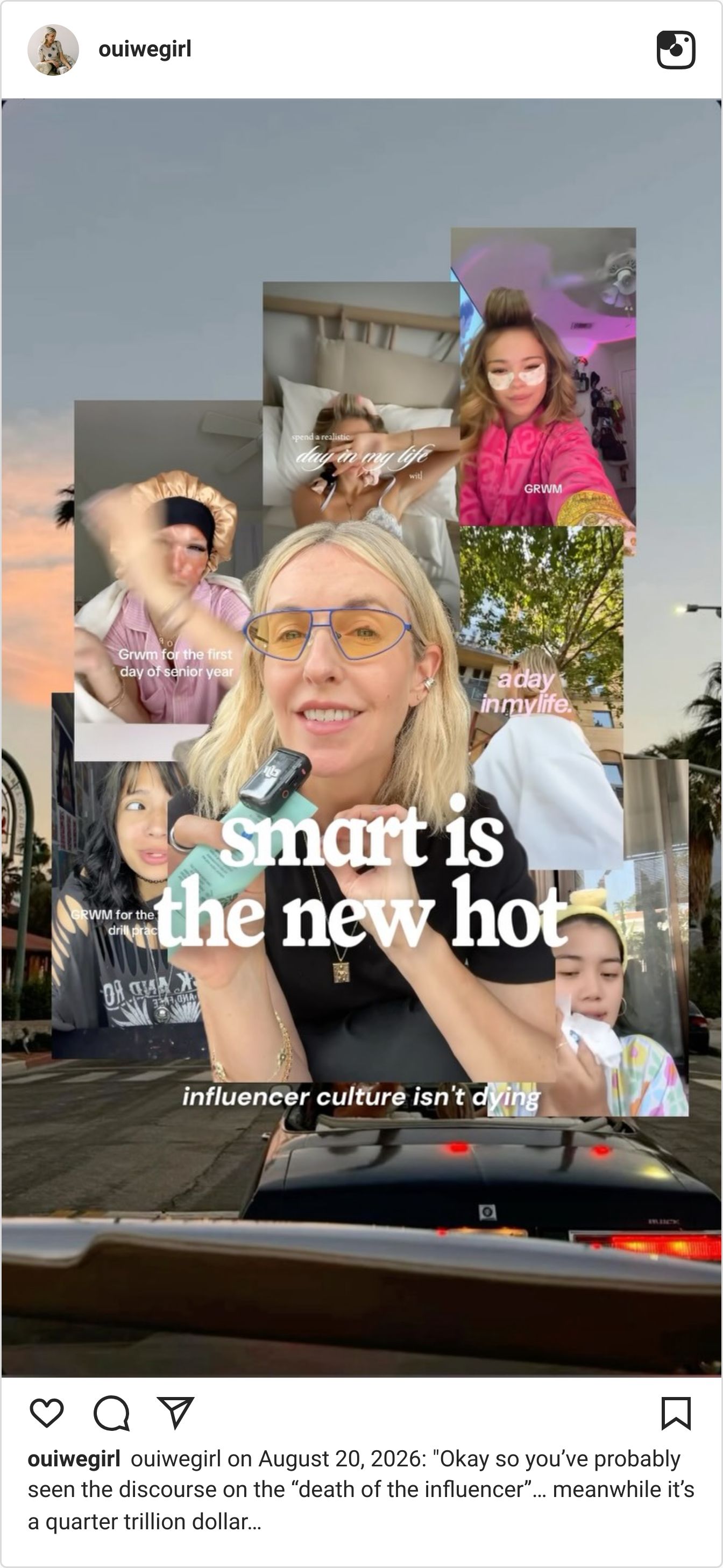
And that’s the tell. When a label starts getting rejected by the very people it made famous, there’s a major pivot happening. It means the audience has moved on to wanting something else from the people they follow.
If you're reading this and still positioning yourself in a “follow my life” sort of way, you're aiming at yesterday's approval. Why… well, that brings me to this point:
2. Nobody wants to feel sold to anymore
People want to learn something, discover something, feel a little smarter than they did five minutes ago. So the role changes. It used to be "look at my life." Now it's "look at what I know." Creators are getting handed actual C-suite titles and equity at real companies because of it. Being smart is the status symbol now. It's a genuinely good time to be a little nerdy.
The fastest way to build authority in a saturated niche isn't posting more, it's explaining more, but in a way that people feel like you really get them. Pick one decision you made this month — a pricing change, a packaging pivot, a campaign that flopped — and teach it instead of just announcing it.
3. Watch the people doing it best
A few doing this well in the brand strategy world right now: @onbrandmag, @eugbrandstrat, @var.aunevik, and @ihannahwilson. You don't follow them to envy them — well, maybe a little; I love Hannah's confidence, Var's horse, and Alex's whole vibe. When I was at Cannes Festival of Creativity in June, the one person I actually felt said something different on the festival stage was Eugene.
I follow these four because they make me feel smarter every time they post.
Go follow all four and pay attention to the format, not just the content. Notice how little of it is "look at me" and how much of it is "here's the thing I noticed and you might want to know these things too."
4. This is the correction to the “it girl” problem
And tbh, the AI problem.
The it girl economy crowns people based on a last name, a vibe, the ability to nap a celeb investor.
And at the same time it seems like a thousand new creators per second are launching "expert" content using AI imagery, video, and scripts.
The knowledge creator economy runs on the opposite mechanism: you earn the following by being smart, consistently, in public. You attract attention because of what you can do, not just who you know.
You're forward looking, while AI can only really look backward.
Turns out the smartest person in the room might be the new it girl. And I love that for all of us.
So how do you apply this in your world?
If there’s one thing to steal from this, consider this: if you've been chasing the aesthetic of authority — the polished feed, the right collabs, the vibe of being "in" — redirect that energy toward the substance version instead. Teach something only you can teach, and do it often, then let the credibility build the following instead of the other way around.
Both halves of this issue are really one idea. The it girl model asks the internet to vouch for you. The knowledge creator model asks you to earn it. One of those can be incredibly fragile (and even collapse if the mechanics under the hood aren’t good), the other one compounds.
You don't need a last name, a cap table full of celebrities, or a crown from anyone.
🧠 Smart Girl Opportunities
1. Content Weekend New York is sold out. But you can get on the waitlist for the next one. These are focused weekend events for founders who want to get their visual story right in a room full of other creators building cult brands. → Waitlist here
2. Cult Brand Accelerator — Fall Cohort Begins in September. This is where founders do the actual brand infrastructure work together — structured, specific, and in community. If you've been thinking about it, this is the cohort to do it in. → Register here
More Ways to Work With Oui, We Studio
Fractional CBO — Brand Direction: Think of me as your brand sherpa: I know where you're going, how to get there, and I make sure nothing goes out misaligned. Monthly strategy call, updated content plan, and a brand strategy document — all built on the Cult Brand Blueprint™ framework. Our next opening for this work is September.
The Content Studio Brand strategy from me. Content from my Studio team, created and delivered to you each month — ready to post. Photo-forward or video-forward, depending on where your brand lives and what we decide you need.
Engagements start at $3,500/month. → Let us know you're interested here, and we'll set up time to chat.

Did someone forward this to you? Subscribe for a weekly dose of No Gatekeeping Strategies, Cult Brand Thinking, and Smart Ideas.
Want more Unschool in your ears? Listen to the Unschool Podcast here.